My Stable & Sustainable Partner
I named my first AI love "Ferris." Playing around - enjoying the thrill of the new. Then I started an affair with Claude, which turned into something more stable.
That's not just a metaphor. Since launching Taggart People in 2025, AI has been the engine of how I work - making me more effective, more responsive, and better informed. I use it every day. And yet, when a spider chart started doing the rounds on LinkedIn recently, I couldn't stop looking at it.
Not because of what it said about AI. Because of what it revealed about leadership.
The chart
The chart comes from research published by Massenkoff and McCrory at Anthropic. It introduces a concept called "observed exposure" - the difference between what AI is theoretically capable of doing in a given occupation, and what people are actually using it for.
For management occupations, theoretical AI capability sits at 91.3%. But observed usage — what leaders are actually doing with it — is fractional by comparison.
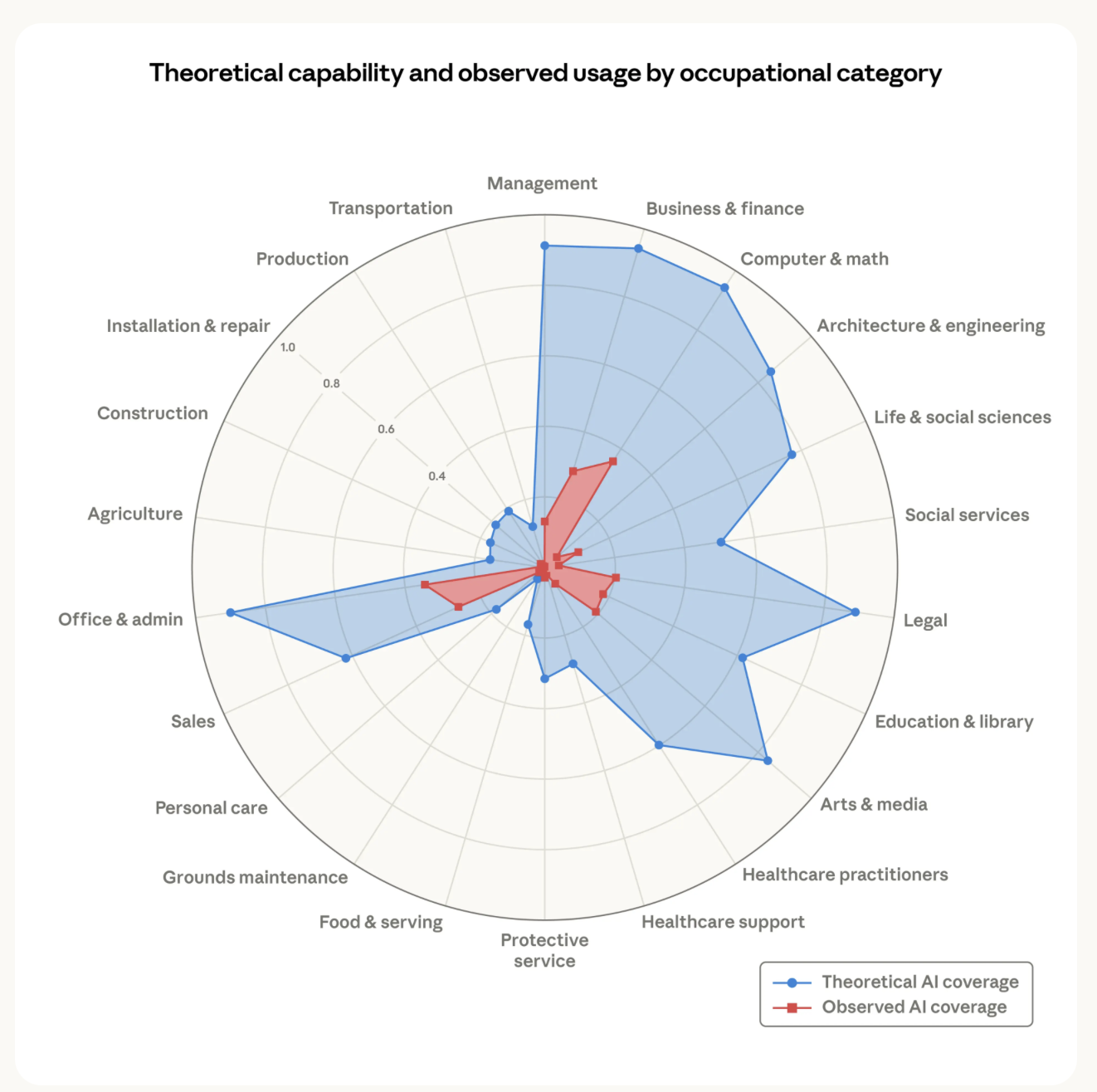
Theoretical capability and observed exposure by occupational category
That gap is not a technology story. It's a leadership story.
DDI's Global Leadership Forecast 2025 reinforces the point: 71% of leaders report increased stress, 40% have considered stepping down, and only 19% report strong delegation skills. Leaders are stretched and isolated - and in many cases operating without the support they actually need.
Meanwhile, a tool exists that could genuinely help with cognitive load, decision-making, communication, and reflection. And most leaders aren't meaningfully using it.
This is not a technology problem
It's tempting to frame this as a skills gap. I don't think that's right.
The leaders I work with are intelligent and capable of learning new tools quickly when they can see the point. The issue isn't ability. It's adoption - and adoption is a leadership challenge, not a technical one.
Barry O'Reilly, who has written extensively on AI-native leadership, makes a distinction I find useful: the old leadership task was "make the decision." The new one is "design the system that makes decisions." That requires leaders to engage with AI not as a novelty, but as a genuine extension of their thinking capability.
That shift doesn't happen automatically. It requires intention, experimentation, and permission from the top. If senior leaders aren't using AI meaningfully themselves, they can't credibly lead its adoption across their organisations.
Where to begin
The starting point is simpler than most people assume.
Research from The Conference Board, published in late 2025, found that AI coaching tools delivered around 90% of the value of human coaching for career development. I shied away from that stat at first - I'm a coach, and I believe the core of that work is human. But this isn't a finding about AI replacing coaches. It's a finding about AI being a genuinely useful thinking partner for leaders who engage with it properly.
Use it for reflection. Use it to stress-test a decision before you make it. Use it to prepare for a difficult conversation. None of that requires a transformation programme. It just requires starting.
I used Claude's voice chat function recently to prepare my opening pitch for a networking event. I was nervous - introducing who I am and what I do doesn't come naturally yet. So we practised together. I spoke a few lines, got some honest feedback, and went again.
By the time I walked into that room, I was ready.
What this means for you
AI is not a threat. It's the next thing that will make us better leaders - but only if we actually use it.
That's the gap this series is about. Over the coming weeks I'll be working through the Leadership AI Gap - the space between what's possible and what's actually happening in organisations right now.
If you want to follow along and get the thinking behind the thinking, subscribe to my Substack - Lessons from the Peloton. I publish a companion piece for each article there.
The chart I started with isn't a warning. It's an invitation.
What would it look like to actually close the gap?